
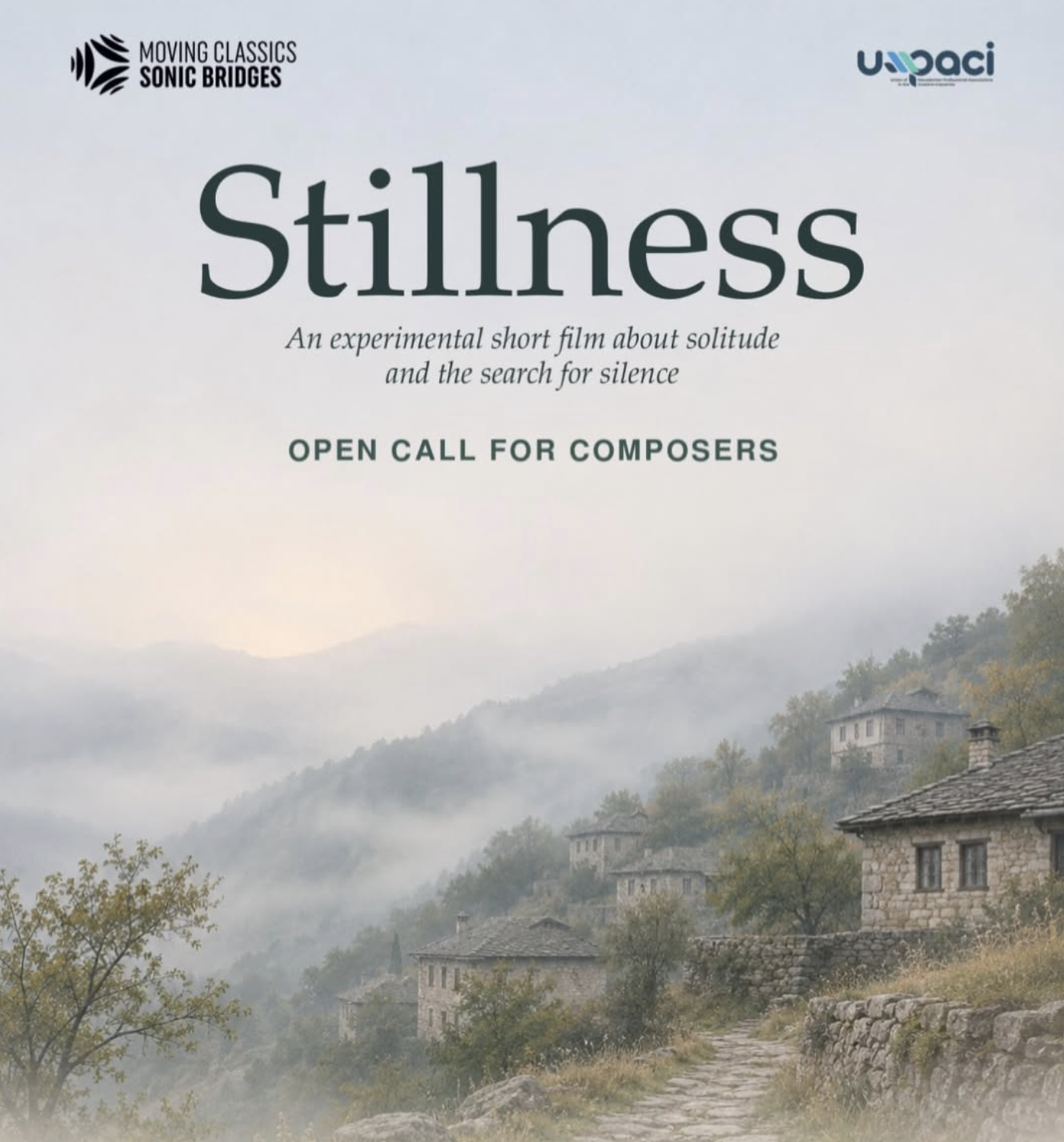
OPEN CALL - COMPOSER/MUSIC COLLABORATOR
COMPOSER FEE
€5,000
APPLICATION DEADLINE
30 November 2026
COLLABORATION
Through 31 March 2027
UMPAKI invites composers and sound artists to create an original score for Stillness, a ten-minute experimental short film directed by Aleksandar Arsovski and produced by Kiril Gjozev within Moving Classics: Sonic Bridges.
The film and the collaboration
What do we hear when the world falls quiet? Through mountain landscapes, empty interiors and fragments of recorded conversations, Stillness explores the fragile boundary between chosen solitude and imposed loneliness. Pauses, breath and ambient sound are as much a part of the film as the words we hear.
Filming is nearly complete. The composer will work closely with the director from the start of editing, sharing musical sketches and testing them against the footage and recorded voices. The composer will also collaborate with the editor and sound team as the cut evolves and compose and produce the original score.
The score will combine electroacoustic ambience, subtle cinematic scoring and minimalist piano. See the Composer Brief on page 2 for the musical direction and the role of silence in the film.
Who can apply
We welcome composers and sound artists from any musical or interdisciplinary background. Applicants must be nationals of or residents in one of the following countries or territories.
European Union All 27 EU Member States.
EFTA countries in the EEA Iceland, Liechtenstein and Norway.
Acceding, candidate and potential candidate countries Albania, Bosnia and Herzegovina, Kosovo, Montenegro, North Macedonia and Serbia.
Neighbourhood Policy countries Armenia, Georgia, Ukraine and Tunisia.
Armenia, Kosovo and Tunisia participate in the Culture strand and Creative Europe Desks. Georgia and Ukraine participate in the Culture and Cross-sectoral strands and in selected MEDIA actions covering talent and skills, European festivals and festival networks, and audience development and film education.
Engagement terms
Composer fee €5,000.
Collaboration period From selection through 31 March 2027.
Travel and accommodation All paid if required.
How to apply
Submit a short bio, links to two or three relevant work samples, and a brief note on how you would approach music, recorded sound and silence in Stillness. Use the dedicated application link in the announcement.
Application deadline Monday, 30 November 2026 at 23:59 CET (Skopje time).
Project website www.sonicbridges.com
Selection process
1. Eligibility and shortlisting UMPAKI will check eligibility and shortlist applicants whose work and proposed approach align with the film.
2. Interviews and decision UMPAKI will interview shortlisted candidates, contact the selected composer directly and officially announce the outcome.
Composer Brief
Stillness / Musical direction for applicants
The emotional brief
We want to develop a musical language for this ten-minute film that brings together electroacoustic ambience, subtle cinematic scoring and minimalist piano. The film explores solitude, alienation, inner unrest and the search for peace.
The score should reveal the emotional tension beneath the images, especially the gap between outward stillness and inner noise. A static, spacious shot can carry unease. For a city scene or a moment involving technology, a faint texture or low tone may be more effective than a forceful rhythm.
The sound palette
· Subtle electronic textures and low-frequency tones
· Organic and electroacoustic sounds
· Environmental noise woven into the score
· Minimalist piano passages
· Restrained string or synthesiser layers
· Distortions, interruptions and sonic irregularities that suggest inner unrest
The piano should feel intimate, fragile and unresolved. Think of isolated notes, short motifs, repetition, small variations and pauses. Keep the emotional register restrained and leave room for the audience to form its own response.
Two roles for the score
Atmosphere In quieter passages, let the music merge with room tone, city noise, electronic devices, wind or water. The transition between sound design and score should be almost imperceptible.
Dramatic movement In selected passages, the music should lead the rhythm and emotional movement of the film. With little conventional narrative action, a shift in the score can signal a transition, build tension or carry a scene towards an emotional peak.
Space for silence
Use the score selectively. Silence and ambient sound are essential parts of the film’s musical structure and need room to be heard on their own.
